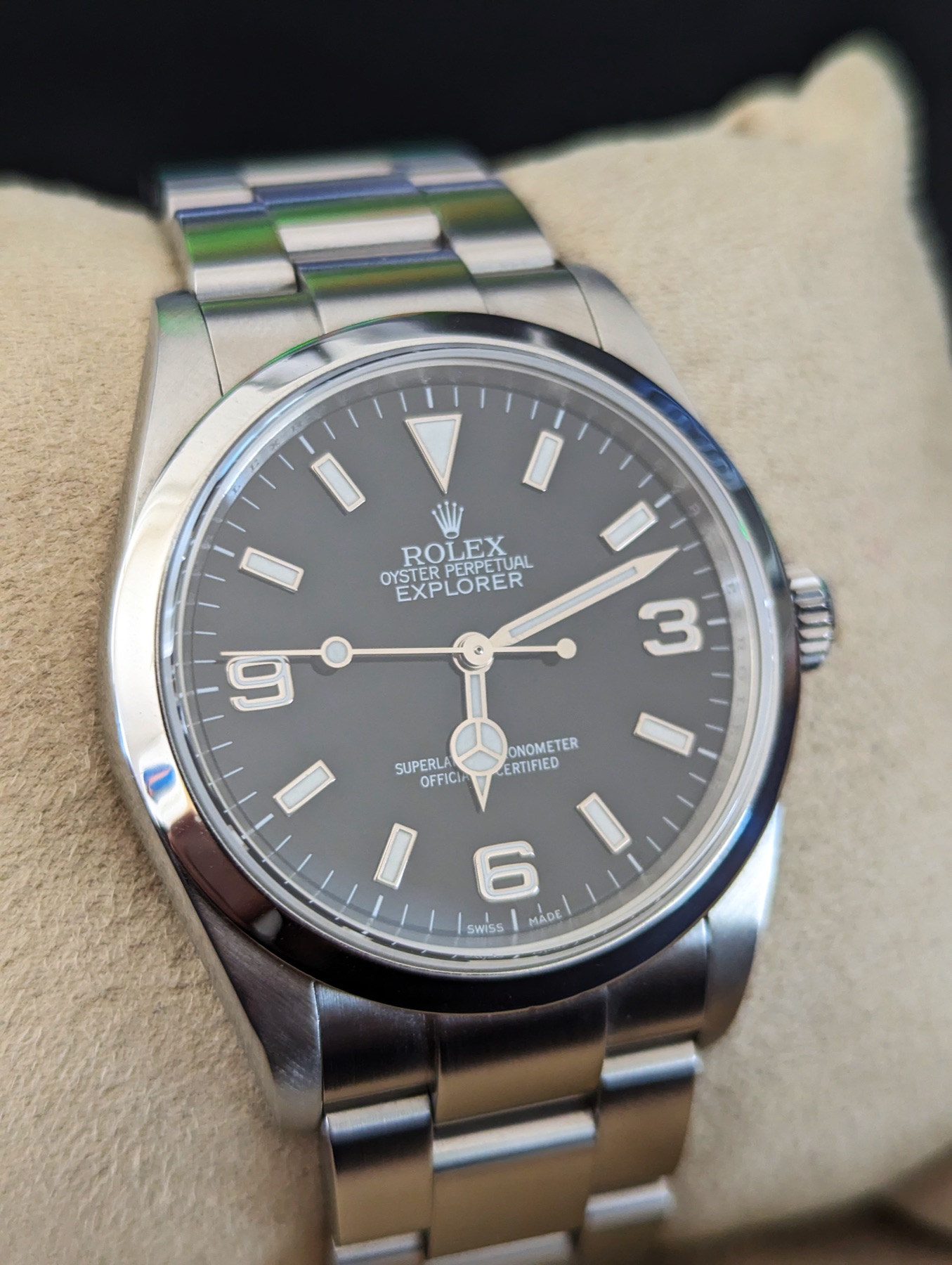
The short answer
Choose an Explorer primarily by generation and proportion. The defining decision is usually 36mm versus 39 or 40mm presence, followed by bracelet, luminous display and the condition of the complete watch.
Compare the decision
At a glance
The Explorer is a time-only professional watch built around a clear three-six-nine dial. Its simplicity places extra attention on proportion, legibility and bracelet fit.
- 36mm and 40mm current formats
- Automatic movement
- Oyster bracelet
- 100m water resistance
Choose by wrist presence
The smaller and larger versions share an identity but wear differently. Compare dial scale, lug span and bracelet balance rather than choosing from diameter alone.
What to look for
Check the case and bracelet together, confirm the reference and included links, and review service history. On earlier generations, dial and luminous-material details can be especially important.
Why simplicity raises the importance of condition
With no rotating bezel or complication to dominate the design, the Explorer’s dial, case geometry and bracelet carry the experience. Heavy refinishing, an incomplete bracelet or mismatched luminous components can therefore change the watch more than a listing grade suggests.
Ask for direct photographs and judge the whole watch rather than treating a clean dial as proof of overall condition.
The WatchAnnex view
The Explorer works when its proportions disappear comfortably into daily wear. Compare relevant dealer inventory by reference and size; use Find a Watch when the preferred generation is not represented rather than treating every three-six-nine dial as equivalent.
Buyer checklist
- Confirm the exact reference rather than relying on case size
- Compare lug-to-lug length and dial opening
- Check luminous material and dial-hand consistency
- Inspect case edges, bracelet, clasp and included links
- Review service documentation and current performance
Photo: Max3351 / Wikimedia Commons · CC BY-SA 4.0 · resized ↗